Marketing Learning In The Age of AI - Part Three
PART 3: How Marketing Learning Needs to Change in the AI Age
The real workplace is becoming the classroom.
“Our junior marketers use AI every day for research. But often, their reports don’t make sense. I have to check them far more than I used to. They hand their work over to AI, but they don’t always know how to scrutinise the results.”
A senior marketing friend shared this with me over coffee last weekend.
He is not alone.
Across many organisations, AI is already helping marketing teams complete research and other routine tasks more quickly. Automated workflows are reducing costs and improving productivity.
Those benefits are valuable.
But with businesses compounding the savings effect of AI by also hiring fewer junior marketers and investing less in training at the same time, there are short- and long-term risks many do not yet see.
Cut marketing learning and development now, and you weaken the talent pipeline your organisation will need in the future.
The answer is not to stop using AI. It is to change how people learn to use it.
Some organisations are beginning to rethink their approach to talent development. They are teaching people not only how to use AI tools and write effective prompts, but also how to assess the quality of what AI produces.
That is particularly important when the work involves:
Customer insight.
Brand development.
Campaign recommendations.
Strategic decisions.
Anything that could affect the business or its reputation.
They are also changing where learning happens.
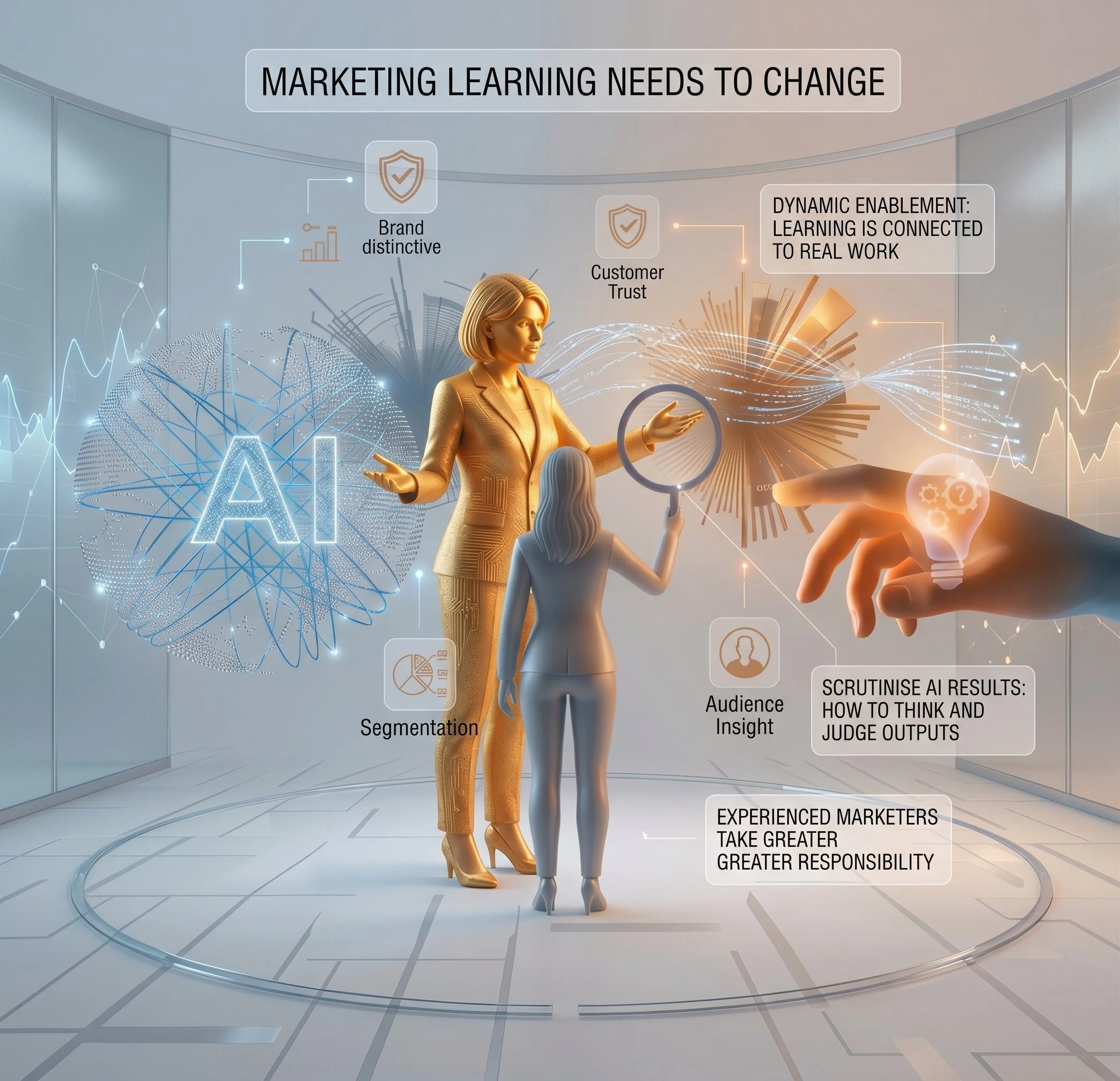
Instead of relying mainly on off-site courses, generic e-learning and training programmes designed around job titles that are constantly changing, more organisations are making managers responsible for learning on the job.
The work itself becomes the classroom.
For example, a junior marketer might draft a campaign brief using their own knowledge and a structured template. They could then review it with an experienced marketer, compare it with an AI-generated version and discuss what makes one brief stronger than the other.
That process teaches more than how to create a brief.
It teaches people how to think, what good looks like and how to judge the quality of AI output.
It also gives them the opportunity to learn at the moment they need the knowledge, rather than attending a workshop and trying to apply it months later.
Josh Bersin refers to this approach as dynamic enablement.
I would call it marketing apprenticeship.
Whatever we choose to call it, the principle is the same: learning needs to be connected to real work, real decisions and real feedback.
And according to Bersin, organisations taking this approach are six times more likely to achieve their financial targets.
The one-off workshop is not enough.
Neither is a generic e-learning course or a training plan built around a role that may already have changed by the time the course is completed.
What replaces them does not need to be complicated. It simply needs to be closer to the work itself.
Experienced marketers need to take greater responsibility for helping others build the judgment, confidence and capability to work effectively in the age of AI.
What is one thing your team could learn this week through real work, instead of attending another course about it?